
Latest Posts
02.10.13 - Hycroft Gate
- Author: DJL
- Categories: Architecture, Education, Nature
- Comments: 0
- Tags: alexander mcrae, general mcrae, hycroft manor, Leonard Frank, shaughnessy, university womens club, Vancouver

After General Alexander Duncan McRae settled in Vancouver in 1907 he build a home for his family in Shaughnessy which became known as Hycroft Manor. The home was built on the brow of a hill on 5 1/2 acres.
 Hycroft Manor 1927 Leonard Frank Photographer [Vancouver Archives]

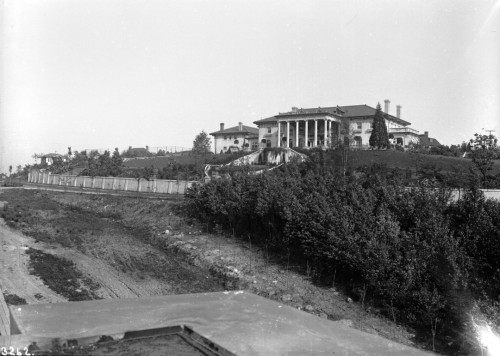 Hycroft Manor 1912 Stuart Thomson Photographer [Vancouver Archives]

Designed by Vancouver architect Thomas Hooper, the land and construction upon which the 30 room 3 story structure was build, cost $109,00 in 1911. After the death of his wife Blanche McRae in 1942, Hycroft Manor was donated to the Government of Canada. During the war the property was the site of the Shaughnessy Military Hospital, and served as an auxiliary facility for 18 years. It was eventually taken over by the University Women’s Club in 1962 who manage the facility to this day.
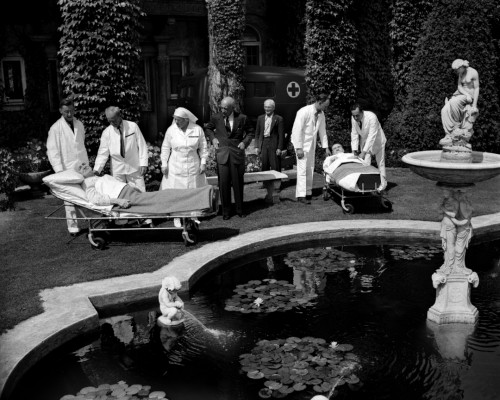 Shaugnessy Military Auxillary 1943 Williams Bros. Collection [Vancouver Archives]

Although this unused gate suggests a prohibitive state of inactivity, the vibrant green suggests quite another story. The University Women’s Club of Vancouver has been promoting education, rights and opportunities for women for over a 100 years.

01.09.13 - L’Institut de Monde Arabe
- Author: DJL
- Categories: Architecture, Travel
- Comments: 0
- Tags: Arabe, Architecture, Institut de Monde Arabe, Jean Nouvel, Paris, research, spiritual values
The brilliant metallic screen at the Institut de Monde Arabe, with it’s moving geometric motifs, is visible through the building’s exterior glass wall. The 240 motifs contain photo-sensitive mechanically controlled apertures, which act as a sophisticated ‘brise soleil’. The photoelectric lenses automatically open and close to control the amount of sunlight and heat entering the building. The effect is reminiscent of Arabic latticework and creates beautiful filtered light, which is often represented in Islamic architecture.
The IMA, founded in Paris in 1980, is an organization of 18 Arab countries and France. It was established to research and disseminate information about the Arab world, its cultural and spiritual values.
 Designed by french architect, Jean Nouvel – Rue des Fossés, Saint Bernard, 5eme Arrondissement, Paris

30.08.13 - Sólfar
- Author: DJL
- Categories: Artists, Travel
- Comments: 0
- Tags: Iceland, Jón Gunnar Árnason, Lýðveldið Ísland, Reykjavík, Solfar, Sun Voyager
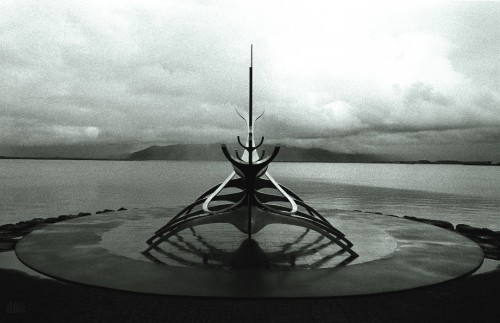 Sólfar [Sun Voyager] a dreamboat, an ode to the sun by Jón Gunnar Árnason (1931 – 1989)

In an interview published in Þjóðviljinn on June 11, 1987, Jón Gunnar describes the genesis of this work as being part of the Scandinavian art project, Experimental Environment, which conducted various artistic experiments in places like Denmark and Iceland in the 1980s. The sun ship symbolizes the promise of new, undiscovered territory. It is located in Sæbraut, central Reykjavík, Lýðveldið Ísland.