
Nature
20.03.14 - Yelapa – the gathering place
- Author: DJL
- Categories: Environment, Nature, Travel
- Comments: Comments Closed
- Tags: beach, los narjanos, Mexico, rio, sky temple, sun, tecomata, yelapa
Yelapa is a unique, small Mexican village of about 1,500 native residents, of which 300 are super relaxed semi-resident Gringos.

A little more than a decade ago, the village operated without electricity, it now arrives by wire or by solar cell. The evenings are quiet once again without the churning generators. This car-free village on the Bahía de Banderas, is made for walking, and you require a genuine affection for the numerous and revered stray dogs. The heavy lifting is accommodated by the many burros, without resistance.
In the 60’s, Yelapa was discovered by the those alternative types from the film and music industries and other gringos found it to their liking and moved in. In those days there were few brick or cement houses only palapas with palm frond roofs and bamboo walls for privacy. Los Naranjos, a jungle retreat, sports this type of accommodations. The place is just magical. Located on a sprawling and well appointed orange grove, the water source is siphoned from their own private waterfall.

Endless diversions lead you off the main walking path. A hike to Sky Temple is as meditative as it is challenging, with strategically places alters, presenting the world’s yogic luminaries. The cross town road gracefully meanders to Verana, a hotel perched on the side of a hill. Along the way there are art installations and mysterious paths that lead to the water’s edge.
A slice of lemon pie may be had by the local temptress known as the pie lady. The pace of Yelapa flows gently or not at all, the latter usually end up at la playa, with eyes closed, absorbing the brilliant sun.
20.01.14 - NEOPAN 400 – END OF THE ROAD
- Author: DJL
- Categories: Film, Nature
- Comments: Comments Closed
- Tags: Fog, Fuji, Multiple Exposure, NEOPAN 400, Nikon FM, Vancouver
FUJI announced that it was time for their NEOPAN 400 professional to drop into analogue history. In July 2013, Gabriel Da Costa, product manager for professional film, stated that “Due to the prominence that digital has in today’s society combined with a decline in global demand of traditional films, Fujifilm has had to make a difficult decision to withdraw a number of films from its range.”

I uncovered a few unprocessed roles of Fuji Neopan 400 from the early ’90s, oddly around the time it was gaining momentum in the market. With a process before date of 1992, I was very skeptical that anything would appear. It was described as an interesting, new exciting film with finer grain. It was often noted as being too muddy in it’s gray tones, especially the lighter tonal scale. To my surprise half a dozen frames of the film were rewound into its’ cassette. Producing a curious multiple exposure, with a mystery dude smack in the middle of the blueberry patch, the burning sun and my vintage ’80s sedan.
In my naive understanding of what the NEOPAN 400 was not suited for, I made my way to strawberry patch in the thick January morning fog. Other ‘not suitable for situations’ include snowy landscapes, clouds without much separation between blue sky due to the lack of brilliancy in the highlights, anything that that can appear grey on grey. NEOPAN 400 was develop to rivaled Kodaks’ Tri-X 400 but with finer grain.

Often called a good push processing film, a technique of increasing the development time of a film to increase its’ effective speed. Push processing compensates for underexposed film by over developing it at the processing stage.
Commonly used as a deliberate attempt to salvage usable images when working in poor lighting conditions, but the method can be used when a film has been underexposed accidentally. Push when there are low light conditions to help enhance contrast, colour saturation and increase granularity. Perhaps a few rolls of fresh stock of this analog medium is in order to fully realize the push potential.

02.10.13 - Hycroft Gate
- Author: DJL
- Categories: Architecture, Education, Nature
- Comments: 0
- Tags: alexander mcrae, general mcrae, hycroft manor, Leonard Frank, shaughnessy, university womens club, Vancouver

After General Alexander Duncan McRae settled in Vancouver in 1907 he build a home for his family in Shaughnessy which became known as Hycroft Manor. The home was built on the brow of a hill on 5 1/2 acres.
 Hycroft Manor 1927 Leonard Frank Photographer [Vancouver Archives]

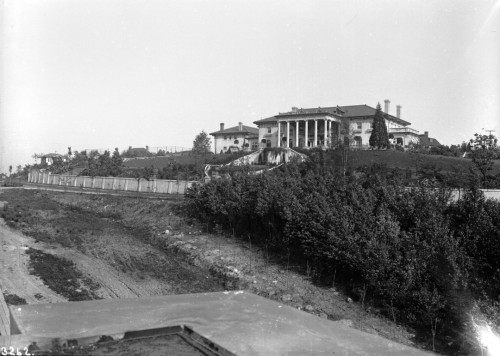 Hycroft Manor 1912 Stuart Thomson Photographer [Vancouver Archives]

Designed by Vancouver architect Thomas Hooper, the land and construction upon which the 30 room 3 story structure was build, cost $109,00 in 1911. After the death of his wife Blanche McRae in 1942, Hycroft Manor was donated to the Government of Canada. During the war the property was the site of the Shaughnessy Military Hospital, and served as an auxiliary facility for 18 years. It was eventually taken over by the University Women’s Club in 1962 who manage the facility to this day.
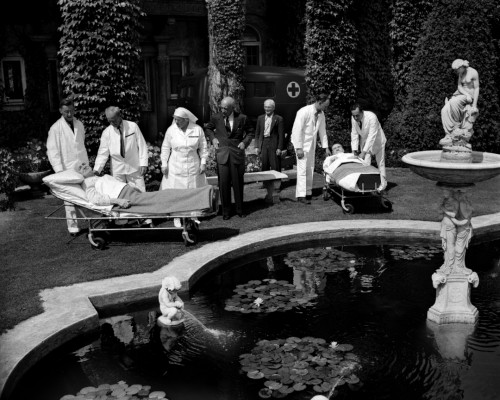 Shaugnessy Military Auxillary 1943 Williams Bros. Collection [Vancouver Archives]

Although this unused gate suggests a prohibitive state of inactivity, the vibrant green suggests quite another story. The University Women’s Club of Vancouver has been promoting education, rights and opportunities for women for over a 100 years.

